
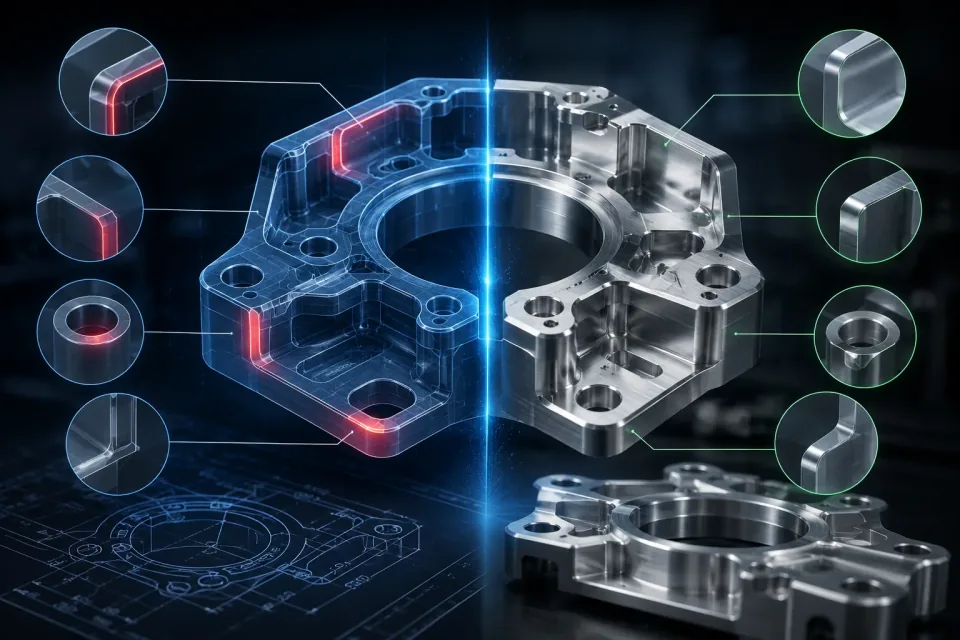
Great design means nothing if you cannot manufacture the part efficiently. Design for Manufacturability (DFM) is the practice of designing components specifically to streamline production. When dealing with elite precision machining, incorporating DFM early prevents massive headaches later. It bridges the gap between theoretical engineering and physical production realities.
Here’s how evaluating tolerances, materials, and workflows optimizes your parts for precision machining and manufacturing.
Evaluating the True Cost of Tight Tolerances
Every dimension on a CAD drawing carries a price tag. While engineers often default to ultra-tight tolerances out of caution, knowing when a feature genuinely needs ±0.0001″ versus a standard ±0.001″ completely changes your budget.
WessDel routinely holds tolerances down to ±0.0002″ for critical features, but applying that same extreme precision to non-essential areas drives up costs for no reason. The initial geometry always dictates the final price tag before the machine even turns on:
- Feature Placement:Blind holes or deeply recessed pockets limit machining accessibility. They require long, flexible cutting tools that increase the risk of errors.
- Setup Demands:Features positioned at awkward angles force machinists to create custom fixtures, which lengthen production times.
- Cost Dictation:Your initial geometry decisions dictate the final manufacturing price tag before the machine even turns on.
Material Choice for Thermal and Mechanical Stability
Material selection is about more than just checking yield strength; you have to understand how a metal behaves under cutting pressure and environmental stress.
In multi-material assemblies, matching thermal expansion coefficients is vital. If mismatched metals expand at different rates under heat, it causes warping, binding, and system misalignment.
To keep scrap rates down and ensure long-term performance, you have to balance machinability with environmental resistance and never skip stress-relieving heat treatments. Because heavy cutting releases trapped internal stresses in the raw stock, post-machining thermal treatments are critical to stabilize the metal, ensuring the part holds its exact dimensions over its entire operational lifespan.
Optimizing the Modern Production Workflow
A smart DFM strategy directly targets shop-floor efficiency to control costs and keep projects on schedule. Utilizing 5-axis machines allows machinists to cut multiple faces in a single setup. This eliminates the need to move parts between machines, drastically reducing handling errors and ensuring perfect feature-to-feature alignment. To further streamline production:
- Standardize internal tooling to ensure strict repeatability across different shifts.
- Use automated inspection probes for real-time quality checks during the cutting cycle.
- Catch dimensional drift instantly to prevent ruining entire batches.
The WessDel Approach to Optimization
The best products are built when engineering and manufacturing collaborate early. Bringing our team in during the prototyping phase allows us to catch production hurdles while your design is still flexible enough to optimize.
Because WessDel is a vertically integrated shop, we handle everything under one roof, from initial DFM reviews to final cleanroom assembly, cutting out the delays of a fragmented supply chain.
While standard project lead times run 10-12 weeks, highly complex builds requiring specialized processing can extend to 20+ weeks. By pairing precision machining with disciplined manufacturing engineering, we ensure your project is built for both performance and manufacturability.
Contact WessDel for CNC Precision Machining and Manufacturing Services
If you’re interested in optimizing your next complex component for efficient production, WessDel is here to help. Our team combines advanced engineering insights with state-of-the-art manufacturing technology to lower costs and maximize accuracy.
Contact us for precision machining and manufacturing today to start your DFM review.